Visa for India from France: steps, fees and official contacts
A French passport does not get you into India without a visa, and none is issued at the airport. You apply online, and the fee must be paid at least 4 days before you land. Two free forms come on top, both to be filled in during the 72 hours before arrival: the arrival card and the Air Suvidha health declaration.
Checked on 23 November 2026 against the Indian government's e-Visa portal, the Air Suvidha portal, the website of the Embassy of India in Paris and France Diplomatie.
Contents
Visa for India: the three things to do before you leave
French citizens need a visa for India, even for a week's holiday. For tourism or business it is an e-Visa: you apply online, with no appointment and without sending your passport anywhere. Most other European, British and American passports follow the same route, with fees that vary by nationality.
| Step | When | Official fee | Where |
|---|---|---|---|
| e-Visa | From 120 to 4 days before arrival | 25 to 200 dollars depending on the type | Indian government e-Visa portal |
| e-Arrival Card | Within 72 hours before arrival | None | Same portal, or the Indian Visa Su-Swagatam app |
| Air Suvidha | Within 72 hours before arrival | None | Indian government Air Suvidha portal |
What has changed recently
- June 2026. The Air Suvidha health declaration is back, because of the Ebola outbreak.
- 15 June 2026. The 30-day tourist e-Visa allows several entries.
- 1 October 2025. The online arrival card, the e-Arrival Card, is compulsory for all foreigners.
- 2025. The embassy in Paris no longer uses the VFS centre. Applications are handed in at the embassy itself.
Indian e-Visa: fees, timing and how to apply online
- Tourist, 30 days
- 25 dollars, about €23 with bank charges
- Tourist, 1 year
- 40 dollars, about €37 with bank charges
- Deadline
- At least 4 days before arrival
- Travel needed
- None, it is all online
How much the e-Visa costs, and which one to choose
| e-Visa | Official fee | With bank charges | Stay | Validity |
|---|---|---|---|---|
| Tourist, 30 days | $25 $10 from April to June | about €23 about €9 | 30 days from the first entry | Enter before the date printed on the e-Visa |
| Tourist, 1 year | $40 | about €37 | 90 days per stay, 180 days per calendar year | 1 year from the date of issue |
| Tourist, 5 years | $200 | about €187 | 90 days per stay, 180 days per calendar year | 5 years from the date of issue |
| Business | $165 | about €155 | 180 days per stay | 1 year from the date of issue |
Fees are charged in US dollars on the portal, which adds 3% in bank charges for a card and 4% for PayPal. Euro amounts include that 3%, at the European Central Bank rate of 20 November 2026. All of these e-Visas allow several entries. The portal also issues medical, conference, transit and student e-Visas.
Not travelling on a French passport? The portal charges by nationality. The 30-day and one-year tourist fees are the same for British, Irish and American passports. The five-year e-Visa costs 484 dollars on a British passport and 160 on an American one. The business e-Visa costs 242 dollars for a British passport, 200 for an Irish one and 140 for an American one.
If you plan to stay more than 30 days, or to go back within the year, the one-year e-Visa works out cheaper than applying twice. It costs 15 dollars more than the 30-day one.
The five-year e-Visa is not always the easy option. At 200 dollars it costs five times the one-year fee, and the money is not returned if the application is refused. The form is the same as for one year. The Indian authorities do, however, come back to five-year applicants more often after submission, asking for evidence of past or planned stays.
How far ahead should you apply?
The Indian portal gives no processing time. It only sets two limits: applications open 120 days before arrival, and the fee must be paid at least 4 days before, otherwise the application is not processed.
There is no fast-track service either, at any price. When a document is not accepted, an email asks you to upload it again, usually within 24 hours. Applying around ten days before departure leaves room to send a new photo or scan.
Applying online: the official site and the steps
- Fill in the form on the official site, the Indian government's e-Visa portal, indianvisaonline.gov.in.
- Upload your photo and the identity page of your passport.
- Pay the fee by card.
- Receive the approval by email. It is called an Electronic Travel Authorization, or ETA.
- Print it and show it at check-in, then at immigration on arrival, where your passport is stamped.
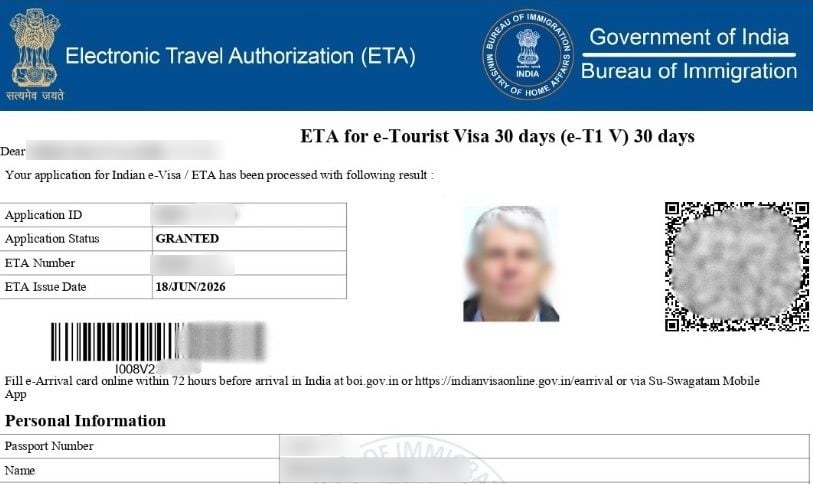
Documents and photo for the Indian e-Visa
- Passport. Valid for at least six months, with two blank pages. France Diplomatie goes further and recommends six months beyond the end of the visa.
- Passport identity page. A PDF between 10 and 300 KB. The two lines of characters at the bottom must be readable, with no glare and no cropped edge.
- Photo. A square JPEG between 10 KB and 1 MB. Facing the camera, no glasses, white background.
- Depending on the purpose. A business card or invitation letter for business, a hospital letter for medical treatment. These must be in English.
The form also asks for both parents' names and places of birth, your occupation and your last Indian visa. Few people have all that to hand. Gathering it before opening the form saves starting again.
Check your photo and passport scan before you apply
The check runs in your browser. Your files are not sent anywhere.
Square JPEG, 10 KB to 1 MB
Have my photo put in the right format Private, paid service offered by the publisher of this guide.
PDF, 10 to 300 KB
Have my passport scan put in the right format Private, paid service offered by the publisher of this guide.
Who cannot apply for an e-Visa
- Serving or retired members of the armed forces, the police and security services.
- People of Pakistani origin, through their parents or grandparents.
- Holders of a diplomatic or official passport.
- Journalists and film crews travelling for a report.
These travellers have to apply for a regular visa.
Where the e-Visa is not enough
An e-Visa lets you enter only through the airports, seaports and land posts India has designated. It does not cover certain protected areas either:
- In the north: parts of Jammu and Kashmir, Himachal Pradesh, Uttarakhand and Rajasthan.
- In the north-east: Sikkim, Arunachal Pradesh, Manipur, Mizoram and Nagaland.
- At sea: part of the Andaman and Nicobar Islands.
Going there takes a permit, to be requested at least 30 days ahead. The usual itineraries are not affected: Delhi, Agra, Jaipur and the cities of Rajasthan, Varanasi, Kerala, Goa.
On your own or through an agency: what changes
| Criterion | Yourself, on the official portal | With help |
|---|---|---|
| Where | indianvisaonline.gov.in | Through an agency, which files on the same portal |
| Cost | The official fee | The official fee plus the price of the service |
| Before sending | No check | Form and photo reviewed |
| If something blocks | Yours to sort out | Handled for you |
Indian e-Visa refused or stuck: what to do
A refusal usually comes with no reason given. A new application is charged like the first, so find out what went wrong before filing again. Otherwise the result will be the same.
The most common reasons for refusal
- A passport number or a name that does not match the passport.
- A passport scan that is blurred, cropped or too heavy.
- A photo that breaks the rules: glasses, a shadow, a coloured background, a rectangular format.
- A duplicate application, or an earlier e-Visa that is still valid.
- A tourist e-Visa requested for an internship, volunteer work with a charity or a report.
What can happen next
- The portal asks for a document. This is not a refusal: upload the photo or scan again from the link in the email.
- The application is refused over a mistake you can fix. You may file a corrected application. The fee has to be paid a second time.
- The refusal is about who you are or why you are travelling. The only route left is a regular visa, at the embassy or consulate.
A regular visa means going there twice. Once to hand in the file, by appointment, and once to collect the passport and give your fingerprints. It takes at least 10 working days. The embassy advises against booking non-refundable tickets before the visa is issued.
e-Arrival Card: India's arrival card, when and how to fill it in
- Who
- All foreigners, OCI holders included
- When
- Within 72 hours before arrival
- Fee
- None
- Time needed
- A few minutes
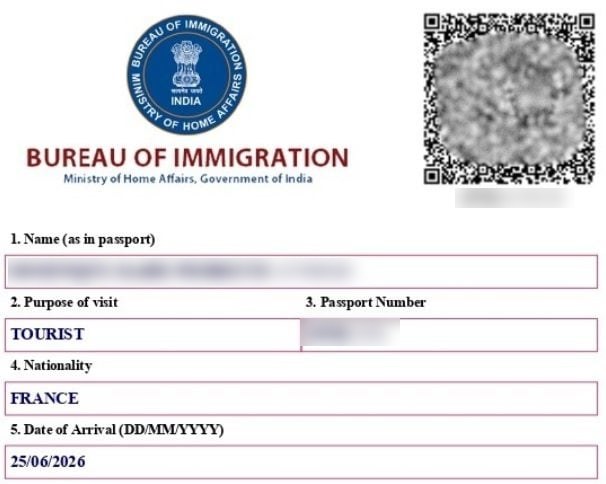
Since 1 October 2025 the e-Arrival Card has replaced the paper slip handed out on the plane. It does not replace the visa, which you still need to hold beforehand. The form stays closed until you are within 72 hours of landing.
How to fill in the e-Arrival Card
- Open the form on the Indian government's e-Visa portal, on the Bureau of Immigration website or in the Indian Visa Su-Swagatam app.
- Enter your passport number and nationality. If your e-Visa has been issued, your name appears by itself.
- Check that your name is spelt exactly as on the e-Visa. A married name that is not on the e-Visa should not be added here.
- Give the purpose of the trip, the arrival date and the address of your first night: hotel name, Indian state and district.
- Add the other travellers in your group, then submit and download the card.
A card covers one entry only. An itinerary that crosses into Nepal or Sri Lanka and then returns to India needs a second one.
Example: a Paris to Delhi flight landing on Friday 11 December
The 72 hours are counted back from landing in India, not from take-off. On an overnight flight, the flying time and the time difference together move the deadline by about half a day. The arrival card and the Air Suvidha declaration follow the same timetable.
| When | What you can do |
|---|---|
| Before Tuesday 8 December | Nothing: both forms are still closed. Have your flight number and first hotel address ready. |
| Tuesday 8 December, 5 am in Paris | The forms open. It is 9.30 am in Delhi, 72 hours before landing. |
| Tuesday 8 or Wednesday 9 December | Fill in both forms, then print them or save them on your phone. |
| Thursday 10 December, at the airport | Still possible, but risky. Terminal wifi is often poor, the confirmation code can be slow to arrive and the check-in desk sometimes asks for the document. |
India is 4 hours 30 minutes ahead of France in winter and 3 hours 30 minutes in summer.
Air Suvidha: the health declaration before arriving in India
- Who
- According to the official portal, all passengers on international flights
- When
- Within 72 hours before arrival
- Fee
- None
- Time needed
- A few minutes
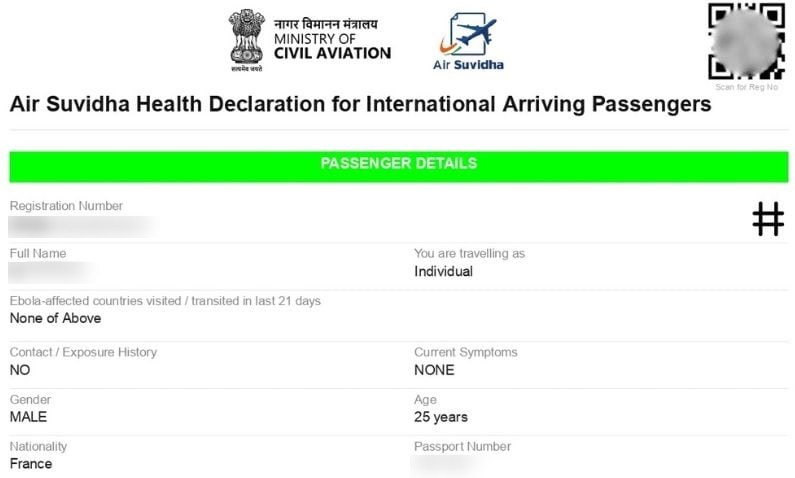
Air Suvidha is an online health declaration run by India's ministries of Health and Civil Aviation. It was created during Covid, dropped, then brought back in June 2026 after the Ebola outbreak. It replaces neither the e-Visa nor the arrival card.
How to fill in Air Suvidha
- Open the form on the Air Suvidha portal, within 72 hours before arrival.
- Enter your name in the same order as on the e-Visa, then your arriving flight: number, airline, airport.
- Declare any Ebola-affected countries you have visited or passed through in the last 21 days, and any symptoms.
- Give your accommodation in India and your home address.
- Confirm with the code sent by email, then download the declaration.
You show the registration number at the health desk on landing. Like the arrival card, the declaration has to be done again for each new entry. The timetable is the same as for the arrival card: see the Paris to Delhi example.
A temporary measure. The Air Suvidha portal presents it as compulsory for all passengers. France Diplomatie describes it mainly for travellers who have been through the affected countries. Until both sources say the same thing, the safe choice is to fill it in. It costs nothing, and the airline may ask for it at boarding.
Regular visa: when do you have to go through the embassy?
- Where
- At the embassy or consulate, by appointment
- Processing
- At least 10 working days
- Fingerprints
- Yes, from age 12 to 70
- Payment
- At the counter, by card or in cash
The e-Visa covers tourism, business, medical treatment and some studies. A regular visa, the sticker placed on a passport page, is still required:
- to work in India;
- for reporting or filming, which fall under the journalist visa;
- for the other people who cannot get an e-Visa, such as members of the armed forces, the police or holders of a diplomatic passport;
- after some e-Visa refusals.
The procedure at the Embassy of India in Paris
- Fill in the regular visa form on the Indian portal, choosing the embassy in Paris. Submitting it online does not register the application: it has to be handed in on paper.
- Print it, sign it in both places and attach two photos in the Indian format, 5 cm by 5 cm.
- Book a slot on the embassy's appointment site. An email confirms the time.
- Go to 20-22 rue Albéric Magnard with your passport, the form and the supporting documents, originals and copies. The embassy asks visitors not to arrive more than 10 minutes early.
- Pay the fee at the counter, by card or in cash.
- Track the file online. When it shows “Granted and printed”, collect the passport between 2 pm and 4.30 pm, no appointment needed. Fingerprints and a photo are taken that day, except under 12 and over 70.
Documents and processing time
- Passport. The original, valid for at least six months when you apply, with two blank pages.
- Non-French passport. A copy of your French residence permit, or a recent electricity, gas or landline bill.
- Child. The travel consent form, signed by the parents. One parent may come to the embassy with the child.
- Processing time. At least 10 working days for a French passport, longer for some visa categories. At least 35 working days for a person of Pakistani origin.
The embassy recommends booking nothing until the visa has been issued.
Embassy of India in Paris and consulates in France
An e-Visa involves neither the embassy nor the consulates. They deal with regular visas, Indian passports and OCI cards. There is no longer an outside application centre: the embassy in Paris states that it no longer works with VFS, and the consulate in Marseille handles everything itself.
Embassy of India in Paris: address, hours and appointments
| Address | 20-22 rue Albéric Magnard, 75016 Paris |
|---|---|
| Phone | +33 1 40 50 71 71 for consular information +33 1 40 50 51 08 for visas |
| [email protected] for visas [email protected] for OCI [email protected] for Indian passports | |
| Office hours | Monday to Friday, 9 am to 1 pm and 1.30 pm to 5.30 pm |
| Visits | By appointment only, booked on the embassy's appointment site |
| Collection | Visas: 2 pm to 4.30 pm. OCI cards: 4 pm to 5 pm |
The embassy says it answers emails first. The chancery, which does not handle visas, is at 13-15 rue Alfred Dehodencq, 75016 Paris, phone +33 1 40 50 70 70.
Consulate of India in Marseille
The consulate general in Marseille handles visas, passports and OCI files itself for people living in the south of France. Appointments are requested by email, at [email protected].
Consulate of India in Saint-Denis, La Réunion
A second consulate general is in Saint-Denis, on Réunion Island. Its details are published on the Contact page of the Embassy of India in Paris.
OCI card: who can apply, what it costs and how
- For whom
- People of Indian origin and their spouses
- First card
- €255
- Processing
- About 30 days
- Where
- At the embassy, by appointment
The OCI card, for Overseas Citizen of India, is reserved for people of Indian origin who have taken another nationality, and for their spouses. It gives them visa-free entry for life. A traveller with no family tie to India cannot apply for it.
Who can apply for an OCI card
- Someone who was an Indian citizen on or after 26 January 1950, or was eligible to become one on that date.
- Their child, grandchild or great-grandchild.
- Someone from a territory that became part of India after 1947, such as Pondicherry, Goa or Sikkim.
- The foreign spouse of an Indian citizen or OCI holder, after two years of registered marriage.
- Descendants, up to the sixth generation, of Indian indentured workers who came to Martinique and Guadeloupe. The embassy looks at these files one by one.
The card is refused to anyone with a parent, grandparent or great-grandparent who held the nationality of Pakistan, Bangladesh or another country designated by India.
The OCI procedure in Paris
- Fill in the application on the Indian OCI services portal and upload the documents and photo.
- Print the form and the copies of the documents, then sign them.
- Book a slot on the embassy's appointment site. Slots are released on the 25th of each month and every Friday, at 9 am.
- Come with the originals. For an application based on marriage, both spouses attend together.
- Give your fingerprints on the spot. Children under 12 and adults over 70 are exempt.
- Track the file online, then collect the card at the embassy between 4 pm and 5 pm. Allow about 30 days after the acknowledgement.
OCI fees at the embassy in Paris
| Application | Fee |
|---|---|
| First OCI card | €255 |
| Conversion of an old PIO card, lost or damaged card | €95 |
| Update, correction, renewal | €26 |
| Update after a new passport, within 90 days of its issue | Free |
These fees are kept whether the application is accepted, refused or withdrawn. The PIO card, for Person of Indian Origin, is the former document: it has not been accepted for entry to India since 31 December 2025.
What slows an OCI file down
- A French birth or marriage certificate without an apostille, the stamp that certifies it for use abroad, or without a certified English translation.
- A photo outside the rules. It must be square, at least 51 mm on each side, on a plain light background, as a JPEG of 200 KB at most.
- A passport valid for less than six months.
- A new passport declared too late. After 90 days the update is charged and needs a new appointment.
A foreign spouse's card is renewed every five years. For a file in progress, the embassy answers at [email protected].
Common questions about the visa for India
Do French citizens need a visa for India?
Yes, whatever the purpose and length of the stay, and it is not issued on arrival. For tourism and business it is an e-Visa, applied for online before departure.
What is the official website for an Indian visa?
The official portal is indianvisaonline.gov.in, run by the Bureau of Immigration of the Indian government. It is the only site that issues the e-Visa. An agency, such as the one run by the publisher of this guide, files the application on that same portal on the traveller's behalf.
How much does the Indian e-Visa cost?
For a French passport, the official fee is 25 dollars for the 30-day tourist e-Visa (10 dollars for an arrival between April and June), 40 dollars for one year, 200 dollars for five years and 165 dollars for the business e-Visa. The portal adds 3% in bank charges. Fees vary by nationality and are not refunded if the application is refused.
How far in advance should I apply for the e-Visa?
The Indian portal accepts applications from 120 days before arrival and requires the fee to be paid at least 4 days before. It gives no processing time and offers no fast-track service. Applying around ten days before departure leaves time to send a document again.
What is the difference between an e-Visa and a regular visa?
The e-Visa is applied for online and arrives by email, with no visit needed. A regular visa is handed in at the embassy or consulate, by appointment, and fingerprints are taken. It is still required to work in India, for journalists and for people who cannot get an e-Visa.
What should I do if my e-Visa is refused?
First find the cause, most often a photo or scan that breaks the rules, a typing mistake or a purpose of travel that does not match the e-Visa requested. You can apply again, but the fee is charged again. When the refusal is about the traveller's profile or the purpose of the stay, the only route is a regular visa, handed in by appointment at the embassy or consulate, with fingerprints taken on collection.
Do I have to print the e-Visa?
Yes. The Indian portal asks travellers to print the approval received by email and show it at immigration, where the passport is stamped. A copy on your phone helps if the sheet goes missing, but does not replace it.
Does a child need their own visa for India?
Yes, at any age. A child travels on a passport in their own name, with an e-Visa applied for separately.
When should I fill in the e-Arrival Card?
In the 72 hours before landing in India, not earlier: the online form stays closed until then. There is nothing to pay.
Is Air Suvidha compulsory to enter India?
The official Air Suvidha portal states that the health declaration is compulsory for all passengers on an international flight to India. It is free and is filled in within 72 hours before arrival. France Diplomatie describes it mainly for travellers who have been through Ebola-affected countries: if in doubt, fill it in.
Where is the Embassy of India in Paris?
The consular section of the Embassy of India, which handles visas, is at 20-22 rue Albéric Magnard, 75016 Paris. Visits are by appointment. The chancery is at 13-15 rue Alfred Dehodencq, 75016 Paris.
Is there still a VFS visa centre for India in France?
No. The Embassy of India in Paris states that it no longer works with VFS. Applications are handed in directly at the embassy or consulate, by appointment.
Can an e-Visa be extended once in India?
No. The Indian portal states that an e-Visa cannot be extended or converted into another visa. If your stay might run past 30 days, apply for the one-year e-Visa from the start.
Method and sources
The rules, fees and addresses come from official sources, consulted on 23 November 2026:
- the Indian government's e-Visa portal, indianvisaonline.gov.in, and its fee tables by country;
- the Air Suvidha portal, airsuvidha.civilaviation.gov.in;
- the website of the Embassy of India in Paris, for contact details, the regular visa and the OCI card;
- the India page of France Diplomatie, in French.
The practical advice, such as the causes of refusal or the caution about the five-year e-Visa, comes from real applications.
Only the Indian authorities decide whether to issue a visa or allow entry. The publisher is identified in the legal notice.
Having your e-Visa application prepared
The official portal is open to everyone. If you would rather hand it over, the application can be prepared and checked before it is sent.
Have my e-Visa application donePrivate, paid service offered by the publisher of this guide, on top of the official fee.